Bikram Yoga Poses: All 26 Postures in Order, With Cues


Bikram yoga is a fixed series of 26 Hatha yoga postures, opened and closed by two breathing exercises, practised in the same order every class in a room heated to about 40°C (105°F). A traditional class takes 90 minutes: a standing series first, then a floor series done lying and kneeling. Most postures are done twice. The same sequence is now often taught as Hot 26 or 26+2.
Class type: hot Hatha, fixed sequence. Level: open to beginners, demanding because of the heat. Props: a mat, a towel on top of it, and water.
Where the Bikram sequence comes from
Bikram Choudhury put the series together from the Hatha yoga he learned in Calcutta under Bishnu Ghosh, the younger brother of Paramahansa Yogananda. He brought it to the United States in the early 1970s and called it Bikram's Beginning Yoga Class. For experienced students he also taught a longer advanced series of 84 postures.
The heat, the mirrors and the spoken dialogue are Bikram's additions. The postures themselves are older and familiar from other Hatha classes: Triangle, Cobra, Camel, a seated twist. For a comparison with other heated styles, read our guide to the types of hot yoga.
How to recognise a Bikram class
- It opens with Standing Deep Breathing and closes with Kapalabhati.
- The postures come in the same order every time, and the teacher follows a set spoken script.
- You breathe through the nose for the whole class and keep your eyes open, including in Savasana.
- The teacher does not practise with you. They teach with words, and traditionally without hands-on adjustments.
- The cues are about alignment: where the weight goes, which knee locks, where the chin points.
- On the floor, you rest in a short Savasana between the postures.
How you breathe in Bikram yoga
You breathe in and out through the nose all the way through. Within that, the postures ask for three patterns:
- Normal breathing: steady breaths through the nose, never emptying the lungs completely. This is the default.
- 80/20 breathing: fill the lungs, then let out about a fifth of the air as you hold the pose, and keep breathing at the top of the breath. Used mostly in backbends, where a full chest helps you hold the lift.
- Exhale into the pose: breathe in fully, then breathe out completely as you fold. Used mostly in forward folds.
The Bikram yoga poses in order
This is the order of a traditional class. Sources count the series in two ways. Bikram's own list numbers 26 items and includes the two breathing exercises and the sit-up. Others count 26 postures plus 2 breathing exercises, which is where the name 26+2 comes from. The postures are the same either way. Under each one you find the cue a teacher repeats most, and a picture of the pose.
Standing Deep Breathing (Pranayama)
Feet together, toes and heels touching. Interlace your fingers under your chin and keep the knuckles against the chin the whole time. Inhale slowly through the nose as the elbows lift, exhale through the mouth as the head tips back and the elbows come together.

The standing series
The standing postures warm the body from the top down: side bend, forward fold, squat, then the balancing postures and the long leg stretches.
Ardha Chandrasana with Pada Hastasana (Half Moon Pose with Hands to Feet Pose)
Interlace your fingers into a tight grip and straighten your arms completely. Bend to the right, to the left, then back, and then fold forward with your hands under your heels. Our guide to Half Moon with Hands to Feet takes all four parts step by step.


Utkatasana (Awkward Pose)
Three parts: sitting back as in a chair, up on the toes, then down on the toes with the knees together. Stomach in, chin up, chest up, weight in the heels in the first part. Sit down more.


Garurasana (Eagle Pose)
Wrap one leg around the other and one arm around the other. Squeeze the knees together and pull the elbows down toward the chest. See our Eagle Pose guide for the wrap.
Dandayamana Janushirasana (Standing Head to Knee Pose)
Lock the standing knee first. Then kick the heel of the lifted leg forward, pull the stomach in and, only when the leg is straight, round down toward the knee. The Standing Head to Knee guide covers each stage.

Dandayamana Dhanurasana (Standing Bow Pulling Pose)
Hold the foot from the inside at the ankle. Kick the foot back and up into your hand while the body comes forward, so the two pull against each other.
Tuladandasana (Balancing Stick Pose)
Arms overhead, one leg reaching back, and the whole body comes down until it is parallel to the floor, from fingertips to toes. Stretch in both directions for about ten seconds. Our Balancing Stick guide explains why it is short and hard.

Dandayamana Bibhaktapada Paschimotthanasana (Standing Separate Leg Stretching Pose)
Feet wide, fold forward and take hold of the heels from the outside. Shift the body weight toward the toes and keep the chin away from the chest. The Standing Separate Leg Stretching guide has the full setup.

Trikanasana (Triangle Pose)
A deep lunge with the arms in one straight line, one hand toward the floor and one toward the ceiling. Stretch up and down at the same time. Bikram's version bends the front knee to 90 degrees, unlike the straight-legged Triangle of most Hatha classes.

Dandayamana Bibhaktapada Janushirasana (Standing Separate Leg Head to Knee Pose)
Palms together overhead, stretch up, then tuck your chin into your chest and round the spine down until the forehead touches the front knee.

Tadasana (Tree Pose)
Standing on one leg with the other foot in half lotus against the hip, or on the inner thigh. Stand tall, straighten the spine, lock the standing knee. Bikram calls this Tadasana, a name most other styles use for Mountain Pose.

Padangustasana (Toe Stand Pose)
From Tree, fold forward from the hip and lower down until you sit on the heel of the standing foot, palms together in front of the chest. This asks a lot of the knee and ankle, so skip the last stage if either complains.
The floor series
You lie down on your back for a two-minute Savasana, and then work through the spine: backbends lying on the belly, kneeling backbends, forward folds and a twist. Between postures you return to Savasana.
Savasana (Dead Body Pose)
Heels together, palms open and turned up, eyes open, mouth closed. Lie completely still. In Bikram this is a posture you practise, and it comes back between every floor posture.
Pavanamuktasana (Wind-Removing Pose)
Lying on your back, hold one knee and then both with a tight grip, elbows in, and pull the knee down toward the shoulder. The Wind-Removing Pose guide explains the grip.
Sit-up
Feet together, toes flexed, arms overhead. Swing the arms up, sit up and fold over the legs with a double exhale through the mouth. The sit-up is how you move from lying on your back to the next posture, and it is not always counted as one of the 26.
Bhujangasana (Cobra Pose)
Hands under the shoulders, elbows in and down along the ribs. Lift the chin away from the chest, look up and lift the chest with the back muscles, not by pushing the hands.

Salabhasana (Locust Pose)
Arms under the body, palms down, chin forward on the towel. Lift one leg, then the other, then both.

Poorna Salabhasana (Full Locust Pose)
Arms out to the sides like airplane wings. Inhale, look up, and lift the arms, chest and legs at the same time, arms reaching back.
Dhanurasana (Bow Pose)
Hold the feet from the outside, a few inches below the toes. Chin away from the chest, look up, and kick the feet back into the hands so the body lifts like a bow.

Supta Vajrasana (Fixed Firm Pose)
Sitting between the heels, lower back onto the elbows and then onto the back. Knees stay together on the floor. Inhale and lift the chest. The Fixed Firm Pose guide has the steps down and back up, and what to do if your knees hurt.

Ardha Kurmasana (Half Tortoise Pose)
Sitting on the heels, palms together overhead, fold forward until the little fingers and forehead touch the floor. Keep stretching forward from the hips while you sit down on the heels.

Ustrasana (Camel Pose)
Kneeling, hands supporting the lower back. Hips forward, chest up, chin up. Look back, inhale, and go back until the hands take hold of the heels. Our Camel Pose guide goes through the backbend in stages.

Sasangasana (Rabbit Pose)
Holding the heels, chin to the chest, roll forward until the top of the head is on the floor near the knees. Stomach in, hips up, only a little weight on the head. See our Rabbit Pose guide.

Janushirasana with Paschimotthanasana (Head to Knee Pose with Stretching Pose)
One leg straight, the other foot against the inner thigh. Interlace your fingers under the foot, elbows in, and bring the face toward the knee, the stomach toward the thigh. Then both legs straight for the Stretching Pose, holding the big toes.


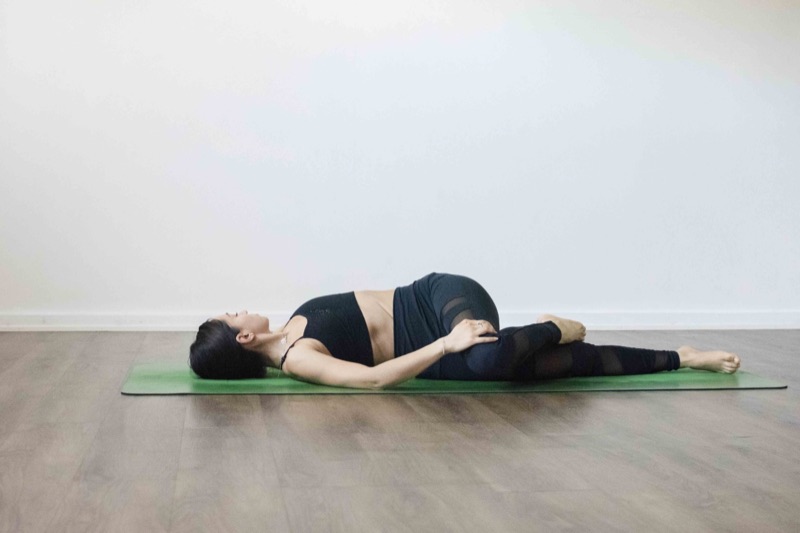
Ardha Matsyendrasana (Spine Twisting Pose)
The seated twist. Find length on the inhale, turn on the exhale, and look back over the shoulder.

Kapalabhati in Vajrasana (Blowing in Firm Pose)
Sitting on your heels with the spine straight, hands on the knees. Relax the belly for a passive inhale and snap it in for a sharp exhale through the lips. Our guide to Kapalabhati explains the technique; most yoga styles do it through the nose, Bikram through the mouth.
A final Savasana closes the class.
How many times you do each posture
Almost every posture is done twice, and one-sided postures twice on each side. The exceptions: Tree Pose and Toe Stand are done once on each side, and so is the Spine Twisting Pose. The first set is longer, and the second is a little shorter and often deeper, because the body is warmer.
Listen to a class
An audio recording of the Bikram beginning class, taught by Esak Garcia.
What the research says about Bikram yoga
A handful of small studies have looked at Bikram yoga. Over eight weeks of regular classes, healthy young adults have shown better hamstring and lower back flexibility, and in one study better balance. Those are the gains you would expect from holding long stretches and standing on one leg, and they come with a caveat: the groups were small, often 20 to 30 people, and most did not compare hot and unheated classes.
Claims you will often read about Bikram go further: that it stimulates the internal organs, improves digestion or helps rheumatism and arthritis. We removed them from this guide. No study we know of supports them for the Bikram series.
Where teachers and sources disagree
- The heat. Bikram teachers say the heat warms the muscles so you can stretch deeper. Sports scientists point out that muscles warm up in a normal room too, and that core temperature can climb above 39°C in a heated class. Both are partly right: the heat makes stretching feel easier, and it also makes it easier to go further than your joints like. Stretch to where you would stop in a cool room.
- Locking the knee. The script tells you to lock the standing knee. Many physiotherapists warn against pushing a knee past straight. In practice, the cue means contracting the thigh muscles so the leg is straight and firm. If your knees hyperextend, keep a micro-bend and firm the thigh instead.
- Where the series comes from. Bikram presented the sequence as drawn from Bishnu Ghosh's teaching, and sometimes as a selection from the 84 postures of his advanced class. How much of the order is Ghosh's and how much is Bikram's own arrangement is not clear from written sources.
Before your first Bikram class
- Eat light, early. Leave two to three hours after a meal. Forward folds and belly-down backbends on a full stomach are unpleasant.
- Drink water through the day before class, and bring a bottle.
- Go slowly. Move in and out of the postures with control, and take the first classes at about half effort. A small change in a pose every week adds up.
- Lie down if you feel dizzy or sick. Staying in the room lying on your mat is always allowed.
- Ask your doctor first if you are pregnant, have a heart condition, low or high blood pressure, or have had heat stroke.
Clothes matter more in a hot room than in a regular class. Our guide on what to wear to hot yoga covers fabrics, towels and grip.
Lauren Matters teaches the sequence pose by pose in the Hot 26 Breakdown, which ends with a 60-minute full class you can do at home.
Frequently asked questions
What are the 26 Bikram postures?
Half Moon with Hands to Feet, Awkward, Eagle, Standing Head to Knee, Standing Bow Pulling, Balancing Stick, Standing Separate Leg Stretching, Triangle, Standing Separate Leg Head to Knee, Tree and Toe Stand in the standing series. Then Savasana, Wind-Removing, Cobra, Locust, Full Locust, Bow, Fixed Firm, Half Tortoise, Camel, Rabbit, Head to Knee with Stretching and Spine Twisting on the floor, plus the sit-up.
What is the 26 and 2 yoga sequence?
26+2 is another name for the Bikram sequence: 26 postures and 2 breathing exercises, Standing Deep Breathing at the start and Kapalabhati at the end. Studios that do not use the Bikram name often call it 26+2, Hot 26 or Original Hot Yoga.
What is the hardest pose in Bikram yoga?
It depends on your body. Many students name Standing Head to Knee, because the standing knee has to stay locked while you balance, or Camel, because the deep backbend in the heat can make you dizzy. Balancing Stick is short but leaves most people out of breath.
How long is a Bikram yoga class?
A traditional class is 90 minutes. Many studios also offer 60-minute versions, which keep all the postures but shorten the holds or do some of them once.
How hot is a Bikram yoga room?
The standard is 40°C (105°F) with about 40% humidity. Some studios run a little cooler. If you are new to heat, a slightly cooler room or a class at home is a good way to learn the postures first.
Can beginners do Bikram yoga?
Yes. The series was taught as a beginning class, and every posture has an easier stage. The heat is the harder part: rest when you need to, drink water, and expect the first few classes to feel long.
Why do you keep your eyes open in Bikram yoga?
You watch yourself in the mirror to check alignment and to keep your balance, and keeping the eyes open in Savasana keeps you awake and present between postures. It is a Bikram rule; most other styles let you close your eyes when you rest.