How to Start a Yoga Journal: What to Write, With a Template


A yoga journal is a notebook where you write down what happens in your practice: how your body and breath felt, what you learned, what you want to work on next time. To start one, keep it short. Write three to five lines right after each class, answer the same few questions every time, and keep the notebook next to your mat so the notes get written before the day takes over.
This guide covers what to write, a simple template you can copy, and what a journal can and cannot do for your practice. (If you were looking for Yoga Journal, the American magazine, that is a different thing. This post is about keeping your own.)
Why keep a yoga journal
A teacher says something in class that makes a pose click. You promise yourself to remember it. After the shower and lunch, it is gone. That is the plainest reason to keep a journal: memory is short, and a note written ten minutes after class holds on to cues, sensations and small breakthroughs that would otherwise fade.
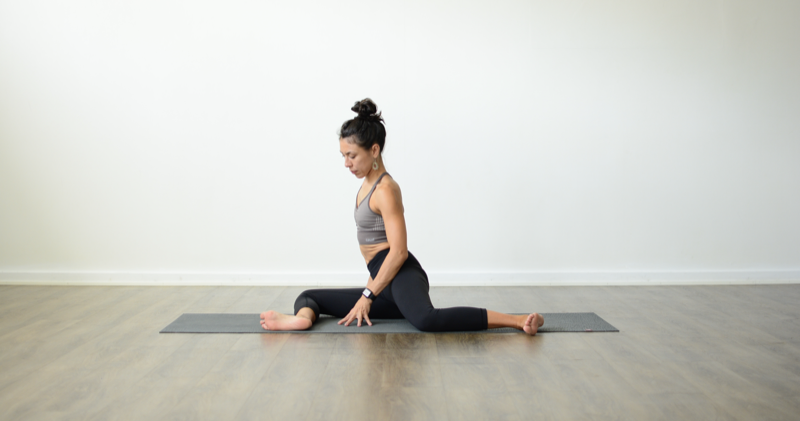
Over weeks, the notes start to show patterns. Your hamstrings are tighter on Monday mornings. Your breath gets short in long holds. The left hip opens later than the right. You only see that when it is written down, and it tells you what to practise. A slow goal like Hanumanasana (Monkey Pose), the front splits, is easier to follow when each small change is on paper.
In the yoga tradition, a related idea is svadhyaya, self-study, one of the five niyamas. More on how close a journal comes to that further down.
How to start a yoga journal in five steps
- Pick one notebook, or one note on your phone. Paper works well because you can leave it on the mat. A phone works if that is where you will write. One place, not three.
- Decide when you write. Right after practice is best, while the sensations are fresh. Two minutes in Savasana (Corpse Pose), sit up, write.
- Use the same short list of questions each time. A fixed template removes the blank page. The one below takes about three minutes.
- Write the date, the class and the length. "Tuesday, 30 min Yin, hips." Later this is how you find entries and compare them.
- Keep it small. One line on a busy day still counts. A habit you keep beats a long entry you write twice and then drop.
What to write: a simple yoga journal template
Copy these questions to the first page of your notebook. Answer the ones that have an answer today and skip the rest.
- Before: How did I arrive? Tired, restless, stiff, sore somewhere?
- Intention: What did I set out to practise, or dedicate the class to?
- Body: Where did I feel the work? What felt tight, what opened, what hurt?
- Breath: Did I hold my breath anywhere? Was it smooth or short?
- Energy: How did I feel after compared with before?
- One thing I learned: a cue, a pose, a detail about myself.
- Next time: one thing to work on in the next practice.
Example entry: "Thu. 45 min Vinyasa. Came in stiff after a long drive. Lower back felt it in Camel, less when I pressed my shins down. Held my breath in Chair twice. Calmer after. Cue: lift the chest before you go back. Next time: breathe out as I sink into Chair."
Prompts for each part of the practice
Your intention
An intention is a short phrase you bring to the mat: patience, steadiness, being kind to a stiff lower back. Some people dedicate the practice to a person. Writing it down before class gives you something to come back to when a pose gets hard. Writing after class, you can note whether you remembered it at all, which is useful information too.
Your body
Name the place. "Tight" is vague. "Tight at the back of the right knee in Downward Dog" is something you can work with. Note pain separately from stretch: a sharp or pinching feeling in a joint is a signal to back off, and if it shows up in the same pose more than once, the journal gives you a clear record to show a teacher. Our guide to practising yoga asana safely covers what to look out for.
Your breath
The breath shows you where you are working too hard. If you held it, write where. Many teachers work in the order breath, form, depth: steady breath first, then alignment, then how far you go. A note like "breath got short in the last round of Sun Salutations" tells you to ease off earlier next time. If you practise Ujjayi, the victorious breath, note whether you could keep it through the standing poses.
Your feelings
You might finish a class feeling light and forget that you came in irritated. Write both. If words are hard to find, a list of emotions helps. Robert Plutchik's wheel of emotions, below, sorts feelings into eight basic ones (joy, trust, fear, surprise, sadness, disgust, anger, anticipation) with stronger and milder versions of each. Pick the one closest to how you feel.

What you learned
Maybe you reached your heels in Ustrasana (Camel Pose) for the first time. Maybe you learned the opening chant of the Ashtanga primary series, or where to rest your gaze with drishti. Write the cue in the teacher's words if you can. Those are the lines worth rereading.
Next time
End every entry with one thing to try in the next practice. It links one class to the next, and it gives you a reason to open the journal again before you roll out the mat.
Where sources disagree
Is journaling svadhyaya? Many yoga teachers call a yoga journal a form of svadhyaya. In the Yoga Sutras of Patanjali, svadhyaya (sva, one's own, and adhyaya, study or recitation) meant study and recitation of sacred texts and mantras. Reading it as study of yourself is a modern extension. It is a reasonable one, since the same Sutras put self-knowledge at the centre, but a diary was not part of the original practice. Journaling as a yoga habit comes from recent decades of studio culture.
Does writing about your feelings help? Psychologists have studied expressive writing since the 1980s, starting with James Pennebaker. Some studies found small benefits for mood and stress. Later reviews found the effects modest and uneven between studies. So a journal is a useful tool for noticing, and it is fair to leave the bigger promises out.
Can it get in the way? Some teachers warn that tracking every pose turns practice into a scoreboard, and that writing about hard feelings can slide into going over them again and again. If the journal starts to feel like grading yourself, write less about poses and more about breath and how you feel. If it keeps you stuck in a difficult feeling, put it down, and talk to someone if that feeling stays.
Common mistakes
- Writing too much. Long entries feel good for a week, then stop. Three lines you write every time are worth more.
- Only recording achievements. The days you felt stiff or distracted tell you as much.
- Writing hours later. The detail of a sensation fades fast. Write within the hour.
- Never rereading. Once a month, read the last few weeks. That is where the patterns show.
If you want something to write about tomorrow, start with a short practice: the two-week meditation program gives you one sitting a day and a natural place to note how it went, and our pranayama classes give the breath section of your journal plenty to say.
Frequently asked questions
What should I write in a yoga journal?
The date and class, how you felt before and after, where you felt the work in your body, how your breath was, one thing you learned and one thing to work on next time. Three to five lines is enough.
How do I start a yoga journal as a beginner?
Pick one notebook, keep it by your mat and write for two or three minutes after each class, using the same short list of questions. Beginners have the most to note, because every class brings a new pose or cue. Our guide to essential yoga poses for beginners gives you the names to write down.
When is the best time to write in a yoga journal?
Right after practice, while the sensations are fresh. Some people also write a line before class to set an intention and compare it afterwards.
How often should I write in my yoga journal?
After every practice if you can, even one line. If that is too much, once a week works: note the classes you did and what stood out.
Is a yoga journal the same as the Yoga Journal magazine?
No. Yoga Journal is an American yoga magazine founded in the 1970s. A yoga journal, lower case, is your own notebook about your practice.
Is keeping a yoga journal part of traditional yoga?
Not in the form of a diary. It is often linked to svadhyaya, self-study, one of the niyamas in the Yoga Sutras, which originally meant study and recitation of sacred texts. The journal is a modern way to practise that idea of paying attention to yourself.