Trapezius and Yoga: Anatomy, Stretches and Strength for the Traps


The trapezius is the large, flat, diamond-shaped muscle that covers the back of the neck and the upper back. It has three parts: the upper fibres lift the shoulder blades, the middle fibres draw them together, and the lower fibres pull them down. Upper and lower fibres also rotate the shoulder blades upward so you can lift your arms overhead. In yoga you stretch the upper trapezius with side-bending neck stretches and Eagle arms, and you strengthen the middle and lower parts in poses such as Locust, Cobra and Plank.
Trapezius anatomy
The trapezius is the most superficial muscle of the upper back, lying right under the skin. Left and right together form a diamond, from the base of the skull down to the lowest ribs and out to the tips of the shoulders. The name comes from its shape: each side is a trapezium, a four-sided figure. The lower part of the trapezius lies on top of the upper edge of the latissimus dorsi, not the other way round.

Upper trapezius
Starts at the base of the skull (the external occipital protuberance and the superior nuchal line), the ligamentum nuchae, the strong ligament that runs down the back of the neck, and the spinous process of C7. It ends on the outer third of the collarbone. These are the fibres you feel when you rub the top of your shoulder.
It lifts the shoulder blade (elevation) and helps rotate it upward. With the shoulder fixed, it can also tilt the head to the same side, turn it to the opposite side and draw it back.
Middle trapezius
Starts on the spinous processes of roughly C7 to T3 and runs almost horizontally out to the acromion and the spine of the scapula, the bony ridge across the back of the shoulder blade. Its main job is retraction: it draws the shoulder blades toward the spine.
Lower trapezius
Starts on the spinous processes of T4 to T12 and runs up and out to the inner end of the spine of the scapula. It pulls the shoulder blade down (depression) and helps rotate it upward.
Nerve supply
The accessory nerve (cranial nerve XI) drives the trapezius. Branches from the third and fourth cervical nerves carry sensation and position sense from it.
What the trapezius does in yoga
Almost every pose that uses the arms uses the trapezius, because the arms hang from the shoulder blades and the trapezius steers them. Three situations stand out.
- Arms overhead. In Urdhva Hastasana (Upward Salute), Warrior I and Adho Mukha Svanasana (Downward-Facing Dog), the shoulder blades have to turn upward so the arm can reach past shoulder height. The upper and lower trapezius do that together with the serratus anterior on the side of the ribs.
- Opening the chest. In Bhujangasana (Cobra Pose) and Matsyasana (Fish Pose) the middle trapezius draws the shoulder blades toward each other.
- Keeping the neck long. In Urdhva Mukha Svanasana (Upward-Facing Dog) the lower trapezius pulls the shoulder blades down so the shoulders do not creep up toward the ears.
The shoulder blade itself has its own post: scapula and yoga, mobility and stability.
Tight traps and neck tension
Most people who search for the trapezius mean the upper part, the ridge between neck and shoulder that feels hard after a long day at a desk. Tender, tight upper traps are common. They often come with a stiff neck and, in some people, tension-type headaches. Stress plays a part: many people lift their shoulders a few millimetres when they concentrate or worry, and hold them there for hours.
A trapezius strain is a different thing: an overstretched or torn muscle after a fall, a whiplash or a sudden heavy lift. It hurts to move, and it may be bruised. Rest it and see a clinician, not a yoga mat, in the first days.
For everyday tightness, a few small trials of yoga for chronic neck pain have found less pain after several weeks of practice. The studies are small, and they cannot tell whether the stretching, the strengthening or the relaxation did the work. A sensible practice does all three.
Yoga poses to stretch the upper trapezius
Seated neck side stretch
- Sit tall on a block or a chair. Let your arms hang.
- Tip your right ear toward your right shoulder. Keep your left shoulder heavy.
- For more, reach the left fingertips toward the floor, or turn your chin a little down toward your right armpit.
- Stay for five slow breaths. Change sides.
You feel it along the left side of the neck and the top of the left shoulder. Keep it mild. The neck does not need to be pulled with the hand.
Garudasana arms (Eagle arms)
Cross the right arm under the left, bend the elbows and bring the backs of the hands, or the palms, together. Lift the elbows to shoulder height and move them forward, away from the face. This spreads the shoulder blades apart and stretches the middle trapezius and the rhomboids between them. The full pose is in Garudasana (Eagle Pose).
Other stretches
- Thread the Needle. From all fours, slide one arm under the chest and rest that shoulder and the side of the head on the mat. Stretches the back of the shoulder and the middle trapezius.
- Child's Pose with the arms long. A soft stretch for the shoulders and upper back.
- Gomukhasana (Cow Face Pose) arms. Stretches the shoulders in two directions at once; hold a strap between the hands if they do not meet.
Yoga poses to strengthen the middle and lower trapezius
A tight upper trapezius is often not the whole story. Teaching the middle and lower parts to share the work is the other half, and that takes strength.
Salabhasana (Locust Pose)
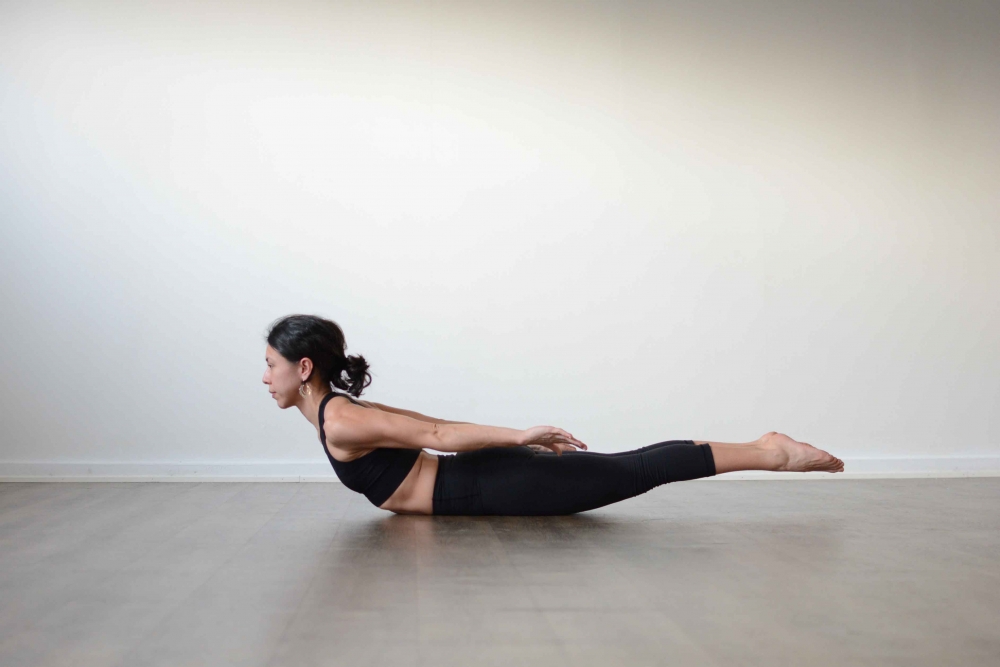
- Lie on your belly, arms by your sides, palms down, forehead on the mat.
- On an inhale, lift the chest, arms and legs a little off the floor. Keep the back of the neck long and look at the floor ahead of you.
- Draw the shoulder blades toward each other and down toward the waist, and reach the fingertips back toward your feet.
- Stay for three to five breaths, lower on an exhale. Repeat three to five times.
To bias the lower trapezius, take the arms out in a wide Y overhead, thumbs up, and lift them a few centimetres. It is harder than it looks. More in Salabhasana (Locust Pose).
Matsyasana (Fish Pose)

- Lie on your back with the legs long. Slide the hands, palms down, under the buttocks.
- Press the forearms and elbows into the floor and draw the shoulder blades together.
- On an inhale, lift the chest. Let the crown of the head rest lightly on the mat, or keep the head lifted.
- Keep the weight in your forearms, not your head. Stay for five breaths, then lift the head and lower the chest.
Fish opens the front of the chest and works the middle trapezius as it holds the shoulder blades back. Skip the head-down version if you have neck problems.
Bhujangasana (Cobra Pose) and Plank
In a low Cobra, lift the hands a centimetre off the floor and hold the chest up with the back muscles alone. The middle and lower trapezius work to keep the shoulder blades back and down. In Plank Pose and Chaturanga Dandasana, the trapezius and serratus hold the shoulder blades steady on the ribs under body weight. Holding Plank with the shoulders away from the ears is a trapezius exercise.
Where sources disagree
"Shoulders down, away from your ears." One of the most common cues in yoga. It helps a student who lifts the shoulders from habit or tension. It is wrong as a rule for arms overhead: to raise the arms fully, the shoulder blades must rotate upward, and the upper trapezius helps with that, so the tops of the shoulders rise a little. Many anatomy teachers now cue "let the shoulder blades turn up with the arms" in Downward Dog and Upward Salute. Both camps agree on the goal: no shrugging that crowds the neck, no forcing the shoulders down.
Weak lower traps and "upper crossed syndrome". The old version of this post said the upper trapezius is overused and the middle and lower parts underused. That picture goes back to the Czech physician Vladimir Janda, who described a pattern of tight upper traps and chest with weak deep neck flexors and lower traps. Physiotherapists use it widely. Research on it is thin, and studies that link posture to neck pain give mixed results. What holds up: strengthening the shoulder and upper back muscles helps many people with neck and shoulder pain.
Stress and the traps. Upper trapezius activity does rise under mental stress in lab studies, and tender traps are common in people with tension-type headache. Whether the tight muscle causes the headache, or both come from the same stress, is not settled. Slow breathing and a longer exhale are a fair place to start either way; see breathing skills for anxiety and stress relief.
Can yoga replace strength training here? Body-weight poses are enough for most beginners. Past a point, the trapezius responds to load, as covered in why yogis need strength training.
For a guided class, Wrist and Neck Therapy is 15 minutes of Hatha for keyboard days, level 1-2, and Shoulder Love is a 25-minute Vinyasa class that moves the shoulders in every direction, level 1-2, with two blocks.
Frequently asked questions
Does yoga help with tight traps?
It can. Side-bending neck stretches and Eagle arms stretch the upper and middle trapezius, and poses such as Locust and Plank strengthen the middle and lower parts so the upper part carries less. Small trials of yoga for chronic neck pain have found less pain after several weeks.
How do you release a tight trapezius?
Sit tall, tip one ear toward the shoulder and let the opposite shoulder hang heavy for five slow breaths on each side. Add Thread the Needle and Child's Pose. Notice when you lift your shoulders during the day and let them drop. Heat and gentle massage help many people too.
What is the best exercise for the trapezius?
It depends on the part. Shrugs load the upper trapezius. Rows and prone Y raises, the arms-overhead version of Locust, work the middle and lower parts. For most people with neck tension the middle and lower trapezius need the work more than the upper.
What are the symptoms of a tight trapezius?
A hard, tender ridge between neck and shoulder, stiffness when you turn or tilt the head, and sometimes a dull ache that spreads up the back of the head. Numbness, tingling or weakness in the arm points to something else and is a reason to see a clinician.
Can a tight trapezius cause headaches?
Tender upper traps are common in people with tension-type headache, and pressing on tight spots in the muscle can bring on pain in the head. Whether the muscle causes the headache or both come from stress is not settled.
Should I pull my shoulders down in yoga?
Not when the arms go overhead. The shoulder blades need to rotate upward, so the tops of the shoulders rise a little. Avoid shrugging that crowds the neck, but do not force the shoulders down either. In Cobra and Upward Dog, drawing the shoulder blades back and down is a good cue.
What are the three parts of the trapezius?
The upper trapezius lifts the shoulder blades, the middle trapezius draws them together, and the lower trapezius pulls them down. Upper and lower fibres together rotate the shoulder blades upward when you raise your arms.